
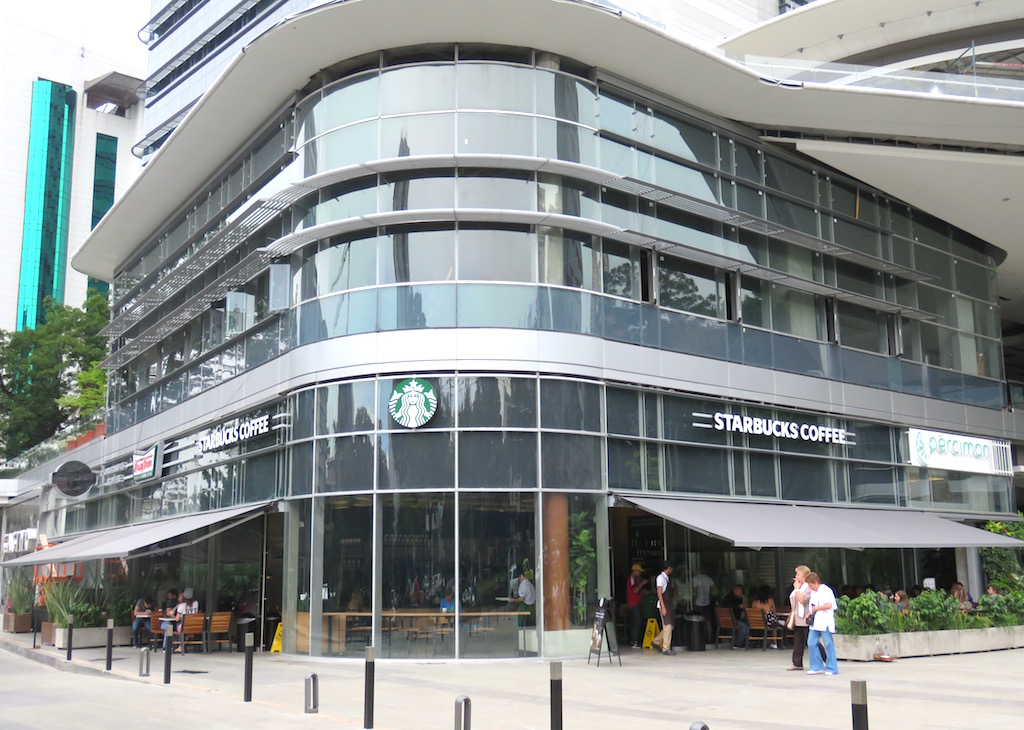
Starbucks opened its first store in Medellín on September 1. I happened to be in El Poblado on this day so I had the opportunity to visit on its opening day.
The new Starbucks is located right next to the Krispy Kreme that opened in March. Starbucks is located in a new building in El Poblado along the Milla de Oro (Golden Mile). This is a short distance from the Papa John’s Pizza, which opened in September last year.
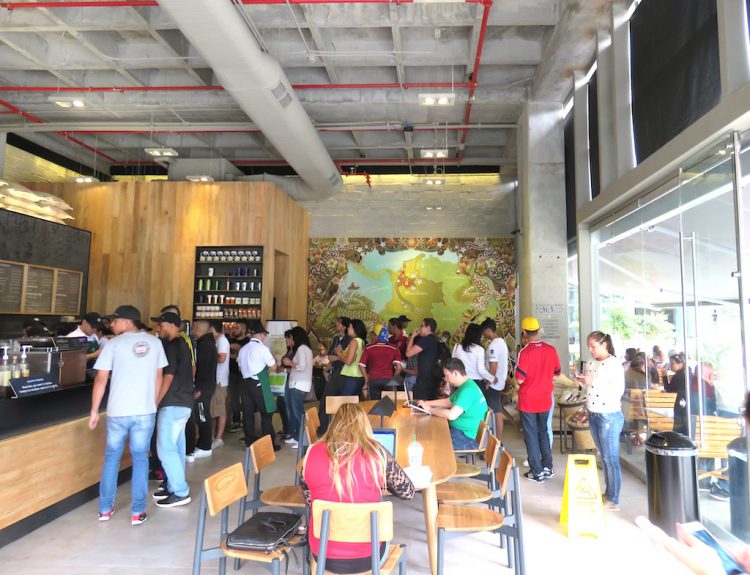
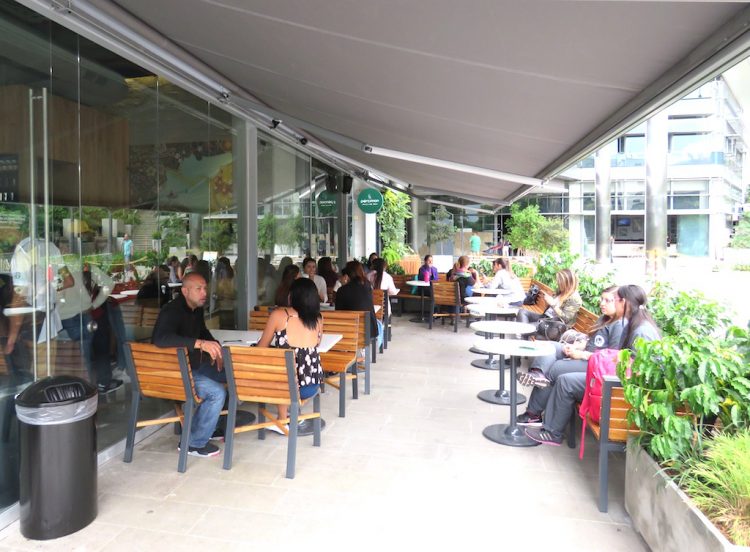
Starbucks reportedly worked with a range of local designers to capture the artistic, creative and modern spirit of Medellín in the new store. The new Medellín store was designed with an open, airy and welcoming layout, which includes community tables and an outdoor patio.
There was a short line at the new store in Medellín when I went on its first day. This was nothing like the line at the company’s first store in Colombia, which I understand on its opening day in 2014, had people waiting for hours in a line that stretched outside the door and along the street.
Starbucks originally entered the Colombian market back on July 14, 2014 with its first store in Bogotá. I happened to be in Bogotá two weeks after its first store in Colombia opened and I wrote about it on this website.
Starbucks now has 10 stores in Bogotá and the new Medellín store is its 11th in Colombia. The company plans to open five more stores in Medellín by the end of next year and 50 stores in Colombia by 2019
Starbucks’ business in Colombian market is a joint venture with Alsea and Grupo Nutresa. Alsea is a big restaurant operator in Latin America running several brands including Burger King, Domino’s Pizza and P.F Chang’s.
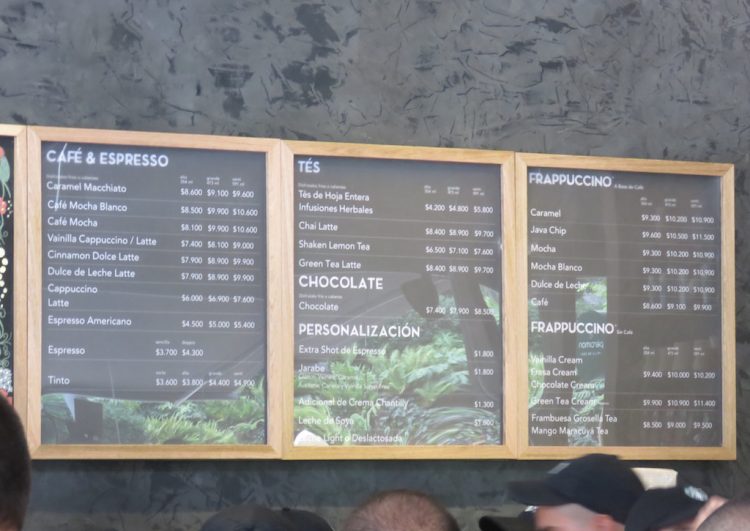
The Menu at Starbucks
The menu at the store includes Coffee, Espresso, Teas, Hot Chocolate and Frappuccino.
Black coffee (tinto) comes in four sizes ranging in prices from 3,600 pesos to 4,900 pesos.
An American Espresso costs 4,500 pesos for a small, 5,000 pesos for a medium and 5,400 pesos for a large.
Hot Chocolate costs 7,400 pesos for a small, 7,900 pesos for a medium and 8,500 pesos for a large.
Caramel Frappuccino costs 9,300 pesos for a small, 10,200 pesos for a medium and 10,900 pesos for a large.
Like most Starbucks the new store in Medellín has free Wifi. I saw several customers with computers in the store using the Internet.
Starbucks in Latin America
Starbucks is a massive company with over 23,000 retail stores located in 65 countries. The company has been in Latin America since 2002 starting out in Mexico and Puerto Rico. The company now has 1,000 stores in 13 countries in Latin America and the Caribbean.
Starbucks opened its first store in Mexico 15 years ago and the company now has over 430 stores in Mexico.
Currently, Starbucks in Colombia reportedly generates 160 direct jobs. The projection for the company is to reach up to 1,000 jobs when its goal of 50 stores is completed by 2019.
The company expects that it will likely enter another city in Colombia next year. My bet is this likely will be in Cartagena.
Starbucks buys about 400 million pounds of coffee per year and more than half of that comes from Latin America, mainly from Colombia.
Starbucks claims its stores in Colombia serve 100 percent locally sourced and roasted coffee for in-store beverages to honor the country’s coffee heritage and the company’s 45-year history of sourcing premium arabica coffee from the region.
In Colombia, Starbucks competes with Juan Valdéz with over 200 stores in the country. Juan Valdéz has stores in 16 additional countries including the United States.
Juan Valdéz’s response to Starbucks’ initial store in Bogotá, Colombia was to open a café in downtown Miami. Juan Valdéz now has six cafés in Maimi and is looking to open more in South Florida.
Which U.S.-based Chain is Next for Medellín?
Medellín has several U.S.-based chain restaurants and fast food places including Burger King, Dunkin’ Donuts, Hard Rock Café, Hooters, McDonalds, Subway, KFC, Domino’s, Papa John’s, Krispy Kreme and now Starbucks.
Bogotá has many more U.S.-based chain restaurants that aren’t available yet in Medellín, including Pizza Hut, Chili’s, TGI Fridays, P.F. Changs and Taco Bell.
I suspect that we may see at least a couple more U.S.-based chains open locations in Medellín over the next few years, with these most likely being U.S.-based chains that are already operating in Bogotá.








Seen the workers outside on Saturday, looked like an orientation. Been to Krispy Kreme couple of times, always empty, worker stated real slow. Hope both can make it being so close to each other.
I live around the corner of the new store and I got the impression that the large number of customers on the opening day were paid crowd media. What a massive disappointment it was to see a Starbucks much less have to look at it everyday. The very last thing that Medellin needs is more corporate encroachment from the USA. Bad enough it’s next to KrispyKreme and across the street from a Hard Rock Cafe. Close your eyes for a moment and you can transport yourself to Paramus, New Jersey.
I personally see this as a good thing. Starbucks is selling 100% Colombian coffee in its stores here in Colombia and they employee Colombians so they are supporting the local economy. The fact that Starbucks chose to enter the market is Colombia two years ago is because Colombia has a growing economy and is underserved with upscale coffeehouses. Starbucks was already a big coffee buyer in Colombia so why not also sell coffee in Colombia. To continue growing Starbucks has to expand in international markets as the US market is saturated.
Medellín is a big city so there are many other parts of the city where you won’t see imported USA brands. Walk down Avenida Poblado in El Poblado and there’s now Starbucks, Krispy Kreme, Papa John’s, Hard Rock Cafe, McDonalds, Burger King… it’s like being in the U.S. Avenida Poblado is also known as Milla de Oro (Golden Mile) for a reason – $$$ – and that’s why these imported places chose this location. El Poblado is a wealthy neighborhood that offers more of a Western lifestyle, but there are many other neighborhoods in the city that offer a more local lifestyle.
All good points Jeff. I personally decided to leave the US because I needed a serious break from the relentless capitalist machine. Starbucks is a decent company in many respects, but I came here looking for new ideas.
You are correct, Poblado is the area of the wealthy, but it is getting out of control.
Every time I travel to Medellin,I stay in Poblado, and I am starting to notice the prices are going up fast. Friday and Saturday night all the restaurants in La Strada center were empty,(might of been the Americanized menu along with the price). In the 6 years I have been going to Poblado, I never paid 22,000 for a glass of Rum Medellin and coke until last week. The only place that was packed on both nights was Papa John, cheap pizza.
I tend to agree with John,my plan is to retire in Medellin to see and live among a new culture and a new way of life. I hope what is happening in Poblado does not spread over to other parts in Medellin.
While you will see some USA brands in other parts of Medellín such as McDonalds, Subway, Burger King, KFC and Domino’s – it’s nothing like you will find in El Poblado.
In other parts of the city the USA brands are primarily found in the shopping malls. For example in Sabaneta, you will find KFC, Subway and Domino’s brands in the very large Mayorca mall. Domino’s also recently opened another pizza place on one of the main Sabaneta roads to support shorter distance pizza deliveries in Sabaneta. But that’s it in Sabaneta and there are hundreds of small local restaurants, tiendas and bars for more of the local culture and lifestyle.
If you are looking for a new culture and new way of life, IMHO westernized El Poblado is not the best place plus it’s the most expensive neighborhood in the city to live. That’s why I have lived over six years in other neighborhoods.
My same thoughts. I’v been traveling to Colombia since 1991 and now live here for the last 6 years.
Fast foods created by America corporate has created fat people with health problems.
English is spoken more in the Parque Ileres area. It’s a dump site for drugs and whores. Back packers with dirty feet who don’t bath makes me ready to move.
Jeff, as always, merci beaucoup for sharing the news, but I have to agree with others: news like this are rather disappointing to most expats who come, or are thinking about coming, to Colombia in search of a new environment which we expect, and want to be, original first and foremost.
As you I am sure know very well, most people who come to live in Colombia do not really miss McDonalds and Starbucks or any other chain franchises, otherwise we’d never leave Seattle, Dallas, Chicago, Boston or Montreal.
Part of enriching one’s experience is traveling the world, living in various natural environments, and learn from that experience. Nothing can be more said than coming to Medellin, Budapest, Dublin, Zagreb or Kiev and see McDonalds and KFC and alike.
I do not have anything against McDonalds and KFC and alike, per se, but in my view they just do not belong in beautiful and diverse original cultures that are so rich and certainly unique enough to be just perfect on their own.
Also, Colombia as a whole, and Medellin in particular, has so many options for the local businesses to appear and thrive, to establish local, original paisa coffee shops, develop their own, originally Colombian, chains.
Finally, having McDonalds and KFC and alike in the most expensive neighborhood of Medellin is somewhat ironic – these fast food chains are not exactly your exclusive chef suit and tie style restaurant.
I hope local people get over these alien corporate implants like people in certain East European countries have got over it and returned to their original selves. I think it serves us all, North Americans and others, just well.
I think its funny to see expats up in arms when these U.S. brands come to a foreign location like Medellín. The bottom line is you have a choice to frequent these U.S. brand locations or not, just like Colombians do.
If you go to a major city in a foreign country it’s rare not see truly global companies like McDonalds, KFC and Starbucks. The companies are experiencing faster growth in international markets than in the U.S.
McDonalds is in over 100 countries and about 75 percent of the company’s revenue comes from outside the US. McDonalds already has over 65 restaurants in Colombia. KFC is another truly global company that is in over 110 countries and it already has more restaurants in China than in the U.S. KFC plans to have over 60 restaurants in Colombia by the end of next year.
Starbucks started its international expansion later than McDonalds and KFC but it is already in 65 countries and the company plans to have 50 coffee shops in Colombia by the end of 2019. These companies wouldn’t be here in Colombia and Medellín if there wasn’t opportunity and demand from Colombians.
Here’s a take on this from my Colombian wife’s aunt when I brought up U.S. brand restaurants in the city in a conversation: “At home we eat rice, beans, meat and arepas. When we leave the house we want to try something different. I’m happy that we have choices from the U.S. to try.”
Being a paramedics for 21 years I see what these type of foods do, high blood pressure, heart problems, diabetes and overweight issues .
I will counter what my Colombia wife stated and I tend to agree. This past visit we starting to see more overweight people than ever before. Is there a connection,only time will tell.
The only good what comes out from these fast food places is employment for the Colombian citizens.
Edit to 2nd paragraph – will counter to what your wife aunt said with what my Colombian wife and I saw this past visit, more overweight people than ever before, connection to fast good, only time will tell.
First of all I do not consider their offerings food, they are food like products, conceived by food scientists in laboratories and the majority of the ingredients are generally cooked in factories elsewhere. I’m sorry to hear from anyone that is considered acceptable eating. That to me is the naive part.
Secondly, corporate American capitalism is on a rampage to force its products wherever people have even a little money to spend: their shareholders demand it. In the wake of that local culture is definitely being eroded. Many expats are just sick of this monster machine, so we leave to find new and fresh local culture and stimulation free of the incessant drone of these brands that care very little about their customers once the sale is made.
The other day, a hot afternoon, I sidestepped a glazed Dunkin Donut that someone had dropped on the sidewalk. In all its chemical glory it refused to melt, even a little, into the concrete.
Demand from Colombians? I have been an advertising and marketing creative director for 40 years and I have been paid well to create demand. Nothing about these international franchises is about demand, it’s about forcing out competition and steamrolling the minds of consumers that this is a fabulous new and exciting alternative to whatever your local culture had to offer. Besides, you saw it on TV!!!
With complete respect, I would look in other directions if you want to find naïveté.
American fast food places don’t have a monopoly on fast food. There are plenty of Colombian fast food places as well. Frisby, El Corral, Jeno’s Pizza, Qbano and many more. These Colombian fast food chains look to be much bigger in Colombia than the international imports from the U.S. Fast food is now part of the culture in Colombia just like in the U.S. and the rest of the world.
I happen to like Starbucks and happened to stop by the new store in Medellin yesterday and there were several expats there and many Colombians.
But, they are Colombian entities. Refreshing if for no other reason than that.
The expats and their much younger prepagos can enjoy a taste of home now. Tourism is on the increase in Colombia. You can see it everywhere. I always crack up when I see the bald, middle aged American with a young chicka from the barrio wearing a belly shirt. They simply dont understand how crazy and pathetic they look. The American just understand that she’s got a Sancho that she see’s every weekend while the American thinks she is visiting her family. At least now he can continue to lie to himself while drinking Starbucks.
John points out that many Yank expats will have left the States to escape rolling thunder capitalism and corporate greed. My experience in many Latin American countries bears that out. However “many expats” is not necessarily the majority. My reasons for hitting the expat road had very little to do with escaping stuff. I almost always worked for corporations and the venal motivation and thinking on the part of capitalist enterprises as described above is not what I saw. I’m positive it exists mind you, but it’s not what characterized my working life. Mostly what I saw was men and women doing their utmost to excel, compete effectively, keep the doors open, play by the rules and have payroll ready for that long line of employees on Friday who had kids to feed. It’s a good thing. I studied business owners carefully looking for common denominators of behavior and one quality stood out; they were able to keep their cool and remain emotionally mature under pressure. As to Starbucks, aka the real topic here, I don’t like their coffee so I don’t go there. If others like it then that’s fine with me. Life ain’t that complicated for me.
As a frequent visitor to Medellin, I am mildly annoyed to see the proliferation of American brands all over town, but I also understand the economics of local jobs. I may not patronize these places, but I am pleased to see people working that might otherwise not have a job. As with any purchase choice, you can either go in or walk on by. I like to contribute to the local economy and try to buy locally sourced products as opposed to the “Brand Name” items. Look inside, for example, the labels of most major brand clothing. You will see it’s origin in some off place. When you overpay for name clothing, you wonder where the profit goes, certainly not to the poor worker assembling the fancy item.
I have walked by this new Starbucks in Medellín many times over the past several months since it opened and it’s fairly busy at all hours so it looks to be successful.
Beautifully stated. Sad but accurate…